Pages

Showing posts with label Mongolia. Show all posts

Monday, October 1, 2012

The 30 Hour Sunday!

For those who have traveled internationally and crossed the International Dateline, this post will be "old hat." For me, today was a new hat.  I mentioned early on that I'd never crossed the Int'l Dateline before, and I was sure it would be an  experience.

Going to Mongolia, it wasn't that big of a deal.  Mongolia is twelve time zones ahead of Lexington, Kentucky.  In other words, 1 p.m. on Monday in Lexington is 1 a.m. on Tuesday in Mongolia.

Coming back to the US, however, this difference takes on some rather bizarre twists.  Like today, for example.

I left Ulaanbaatar, Mongolia's Chinggis Kahn International Airport at 6:45 a.m. Sunday morning. That's 6:45 p.m. Saturday in Lexington.  I saw a beautiful Sunday sunrise as we took off.  I landed in Incheon, South Korea at 10 a.m. Sunday.  After a 7 hour layover, I flew from South Korea to Detroit at 5:20 p.m. Sunday.

We headed due north around North Korea and over China.  Near the China/Russia border, the sun sat on Sunday evening.  A few hours later we crossed the dateline and were in the pre-dawn hours of Sunday morning again!  (You may be wondering how I knew where we were. On the Boeing 777, each seat has a Video on Demand tv screen. There's an option to track the flight.  A world map appears and shows where the plane is at any given moment. Voila!  A flight tracker.)

As we flew near the northern tip of Alaska above the Arctic Circle, I saw another beautiful sunrise...Sunday morning again!  At 5:30 p.m. we  had flown south down through Canada and landed at Detroit.  That's right. We left Incheon at 5:20 p.m. Sunday and landed in Detroit 10 minutes and 11 time zones later.

We fly out of Detroit at 8:04 p.m. and I saw the sunset again on Sunday evening and landed in Lexington at 9:30 p.m. Sunday.  As Jackie and I were heading from the airport to our home in Lexington, I received an email from Hatnaa in Mongolia - 10 a.m. on Monday morning in Ulaanbaatar.

I lived September 30th for 30 hours, saw two sunrises and sunsets on the same day and got an email from Hatnaa on October 1st.  My head is spinning around and around and I'm not sure what day or hour or where exactly I am, but I know I've lived it all before...deja vu all over again.

I'll be contemplating this experience for a long, long time.  Thanks to everyone for the prayers and well-wishes.  I had a Sunday I'll never forget...and I haven't even told half the story.  For example, I was denied boarding in Mongolia three times and once in Incheon.  However, I managed to get on the plane, fly home AND my luggage arrived safe and sound.  I'm counting my blessings!  More on that later...and it is a funny and sobering story for another blog post.

I'M HOME.

Saturday, September 29, 2012

Hard to Say Goodbye...and Other Observations


In a few short hours, I'll get on a plane in Ulaanbaator, Mongolia.  Thirty hours later, I'll touch down at Bluegrass Airport in Lexington, Kentucky.  Two layovers - Incheon, South Korea and Detroit, Michigan.  And, then, home.  My old Kentucky home.

This is not my last post.  It is my goodbye to Mongolia post, however, with a few observations thrown in.

Am I excited to be going home?  I certainly am.  I can't wait to see Jackie and Spicy and sleep in my own bed.  I can't wait to see my family and friends and get back to KLC.  Will I miss Mongolia?  Yes, I definitely will.  Why?  Because I've had an incredible journey here and met so many wonderful people.

Before I leave though, I have one final dinner with Hatnaa tonight.  How do you say goodbye to someone that has put his life on pause and provided you the experience of a lifetime?  I don't know, honestly.  He scheduled twenty meetings for me with people who make decisions that affect an entire nation.  From a Member of Parliament to the Deputy Mayor of Ulaanbaatar.  From the chairman of the General Election Commission to the dean of the National Academy of Governance.  And just as importantly, the directors of the NGOs who work hard every day to improve the quality of life for the everyday citizen of Mongolia.  Heavyweights, one and all.

More than that, Hatnaa and I (along with Einkhtaivan) have shared experiences on the road together driving across the Mongolian countryside and visiting the places that are the essence of this great country.  This experience was supposed to be about "living" the life of a Mongolian.  Understanding what this country was all about.  It lived up to all of the hype and more.

Mongolians are friendly, generous and welcoming.  I learned we share a lot of the same struggles, emotions and frustrations.  I also learned to look at people and places through a different lens.  It's amazing what you can learn when you open your heart, eyes and ears to the world.  I know I'll be coming home with a different perspective.  Maybe a different attitude, too.  I want to do more, see more, be more and help more.  I think that was another purpose of this experience.  My jaded glasses have been removed, thankfully.  I feel alive and inspired and determined.

I don't know what I'll say or how I will feel when we say goodbye.  One thing is certain.  I won't leave feeling the same way I did when I arrived.  I said I wouldn't put my preconceived notions out there prior to experiencing the people and culture of Mongolia.  I'm glad I didn't because I was wrong about many things.  I've laughed at myself and I've been mad at myself.  That's what happens when we make assumptions before we really understand what things are all about. 

I do love this place and these people.  I thank Hatnaa from the bottom of my heart for helping me to see what his people and his country are all about. Goodbye dear friend!  And thank you for everything we did together.  I hope I'll see you again some day.

That's my observation for today.  Peace!


Friday, September 28, 2012

Steps Without Borders NGO

Ms N. Bayarsaikhan is the director of the Steps without Borders NGO and coordinator of the Publish What You Pay Mongolia Coalition. Publish What You Pay works with the Civil Society Council Coalition to address issues related to transparency and accountability within the mining industry.  It is a work in progress to improve civic participation in the local decision making process on issues that impact the environment, economic development and quality of life particularly in the countryside.

 
Ms. Bayarsaikhan is the director of Steps Without Borders NGO
 
Steps without Borders seeks to protect the cultural values of the people of the countryside.  The encroachment of the mining sector on the nomads' grazing lands is having unintended consequences that Steps without Borders hopes to address before it's too late.  The Mongolian people, in general, are close to nature.  It is a critical part of the national identity.  Since the transition to a market economy, the sense of local community and heritage has been lost.  Previously, local communities were very dependent on the central government.  All decisions were made by the central government and everything was very planned and fixed.  Now, planning issues have shifted to the local level.  No history of experience in dealing with planning issues exists on the local level.
 
Steps without Borders is working to change the mindset of people by encouraging them to express their opinions and act to solve their own problems.  People have grown to believe that mining revenue is the answer to everything and will always be around to provide funding for the communities needs.
 
The local and national leadership should be directing their attention to the future.  What happens when mining revenue decreases?  This is an inconvenient truth that politicians do not want to think about.  The country needs to quickly diversify its economy during the good economic times in order to soften the blow when the minerals are gone. 
 
The agriculture sector is focusing on planting practices and improved methods of crop production.  The Ministry of Economic Development is beginning to create industry focused on finshed-product manufacturing instead of exporting the country's raw material.
 
Local communities do not have any options for capturing revenues generated as a result of mining.  All of the revenue goes to the central government.  The Steps without Borders NGO belives that this revenue should be set aside for future development.  There is a lack of political ill to do anything.  Public input on budget issues is very limited.  The government gives the impression that it is beholden to the mining interests.  Steps without Borders NGO is working to open the national dialogue about these and many other issues that affect the future well-being of the country.
 

Tolgoit Community Development Center

Ms. Natsag-Orgi Erdenesuvd is the executive director of the Community Development Center in Tolgoit.  She and her staff are about as grassroots as it gets.  The center addresses the issues and needs of women and is the first Mongolian NGO to specifically address female problems in the Ger districts.

 
Ms. Natsag-Orgi Erdenesuvd, executive director of the Tolgoit Community Development Center is on the left.  The other two ladies are members of her staff.

The concept is simple.  The center provides basic needs for women such as a health care assessment.  From this initial service, doors are opened that foster further conversations about basic legal information for domestic abuse and psychological help for the immigrant population.  The community center's clientele consists primarily of nomads who have been displaced by recent droughts and driven to the outskirts of Ulaanbaator where ger tent cities have sprung up by the hundreds.

The community center is located in a Ger tent.  The familiar surroundings provide a familiar setting for the women who come to the center for assistance.  in 2005, the 1st Civic Workshop to listen to people's needs helped to establish good relations among the residents, the mayor of Ulaanbaatar city and district's Member of Parliament.

In addition to basic health assessments and counseling, the community center has also assisted the neighborhood to create a sustainable food program and established community gardens.  These activities are bringing the community together.  Initially, the center served 8,000 residents in 2004 and has now grown to more than 12,000 people served.  Their target audiences are the poor, disabled and vulnerable.  The center's success has garnered the attention of government and the business community.

The center's first priority is to meet the social needs of the community.  As time goes by, the center has begun to partner with the business community, the health care organizations and labor groups to provide training and education opportunties that will eventually lead to employability.  I appreciated the work of the community center. It really spoke to me.  They utilize the same approach as we do...meet the needs and provide skills that improve the quality of life.


Mongolian National Federation of Disabled People's Organizations

Mr. Tseden Oyunbaatar is the president of the Mongolian Federation of Disabled People's Organizations.  The federation was established in 1997 as an NGO.  In 2004, several organizations merged their efforts to establish a lobby group to seek change in public law through the Parliament.  Seven public laws were passed to address the needs of disabled people.  In 2009, Mongolia participated in the International Convention on Disabled Persons.

The Mongolian laws apply to all soums and aimags equally.  The federation works with the social welfare system to monitor progress and implementation.  Funding only pays for activities; not salaries. 

Currently, 97,000 Mongolians have been identified with some form of physical or mental disability.  A classification system is needed along with guidelines that delineate the government's responsibility in assisting disabled persons.  The current program is administered under the Ministry of Welfare rather than the Ministry of Health.

Mongolians with disabilities are stigmatized and marginalized by society, in general.  Presently there are no teachers or education programs to assist people with special disabilities.  The federation currently has no capacity for training new teachers to address the needs of the people. 

Mr. Oyunbaatar believes that the first step is to conduct a National Needs Assessment for the government.  We discussed the history of the US in addressing these issues.  I suggested that the Americans with Disabilities Act might provide his organization some ideas on potential draft legislation to help Mongolia's disabled persons.  Obviously, significant cultural differences exist between our nations, however, America's long struggle to adequately address the needs of the disabled may provide a model for Mongolia to consider.


Mr. Tseden Oyunbaatar, President, Mongolian National Federation of Disabled People's Organizations is pictured on the far left.

Thursday, September 27, 2012

Erdene Zuu Monastery

Last weekend, we visited the countryside of Mongolia.  We stayed in a ger camp (See Big Black Hole Post and Other Ger Camp posts) and toured the Erdene Zuu Monastery the next day.  Erdene Zuu, founded in 1586, is the oldest Buddhist monastery in Mongolia.  Hatnaa and Einkhtaivan are practicing Buddhists so this trip held special meaning for them.  I learned so much here.

I'm going to let the pictures do the talking.  Erdene Zuu is a beautiful place.  If you want to learn more, just Google it.  A lot of information is available online.

 
One of three ancient temples


Hatnaa and Einkhtaivan at the 2nd temple
 
Roof ornamentation


The present-day working monastery.  We were allowed inside and listened as monks were teaching their students


The present-day temple and prayer wheels


Chinggis Khaan Statue Complex - 3 Goggles and All!

The first time that I searched for Mongolia on Google back in the spring, an image of the Chinggis Khaan Statue Complex popped up.   This statue stands 43 metres high (about 130 feet).   I've wanted to see it ever since that day.  Today was the day!

 
They have big horses in Mongolia!

 
This boot holds the Guinness World Record as the largest shoe in the world.

 
Hatnaa and I throw up the Kentucky 3 goggles while standing on top of the horse's head.  Where are you KSR????

 
That is what I call a landmark worthy of an empire!
 

Wednesday, September 26, 2012

The Big Black Hole on the Road to Kharkorum!

 
Leaving Kharkhorum, the ancient capital city of Khan's Mongolian Empire
 
 
Dark was settling over the vast Mongolian landscape as we rode, bounced, and bobbed our way around potholes and other obstacles on the road to Kharkhorum.  Einkhtaivan is a helluva driver.  (He's pictured on the right in the photo above.)  Worth his weight in gold.
 
We got a late start out of Ulaanbaatar on our way to a ger camp near Kharkhorum. I've already mentioned how I feel about traffic in UB.  It is absolutely nuts.  Traveling around a roundabout, like the one near Shillito Park only bigger (5 lanes of traffic going around a circle), we had a little "scrape" as Hatnaa described it.  A SUV decided to come into our lane while we were trying to get in his lane and we scraped.  Let's just say that Einkhtaivan wasn't very happy, but he and the driver settled the deal and we went on our way.  Einkhtaivan said "Little scrape at the start of a trip means good luck ahead."  Never have any words been so prophetic. 
 
The drive to Kharkhorum takes about 6 or 7 hours depending on how long it takes to get out of city of Ulaanbaatar.  Traffic was horrendous until we hit the freeway at the edge of town.  Then, we were driving through the open plains of the countryside.  Gosh, I love being in the countryside.  It felt familiar to me given my rural heritage. Hatnaa and Einkhtaivan were singing away to the traditional Mongolian music on the mp3 player that blared from the back speakers.
 
As darkness fell, I came to realize that we had traveled almost 300 km and still had 77 km to go.
 
 
Dusk on the road to Kharkhorum
 
As we crossed the welcoming arch to the ancient city, I soon discovered what others were talking about on www.tripadvisor.com.  The roads disappeared.  I mean we were diverted off the road into a field with dusty paths.  Then, magically (and if we made the right choice of paths to follow) we'd pop back up on the blacktopped road again.  This happend about a dozen times.  We drove for miles without ever seeing a light, a house, a car, headlights...nothing but pitch black and the light from our headlamps.
 
Suddenly, we were confronted with 4 car paths.  Einkhtaivan was a pretty good judge of which path to take.  This time however he took the road less traveled by in words of Robert Frost.  Shortly afterwards, he slammed on the brakes and shrieked words that I could only guess as to their meaning.  Out came the flashlights.  Yes, I had mine, too.  We got out of the vehicle.  I kid you not, about a foot in front of us was a big black hole.  A big FREAKING black hole.  We were all just kind of in a daze thinking about what would have happened if Einkhtaivan hadn't had such good eyes.
 
We backed up, turned around and hauled ass out of there!  We met a hippy van and flagged it down to give them a warning as to what was ahead.  The guy shouted back "I know where I'm going.  Just follow me."  Famous last words.  Without missing a beat, he headed straight to the black hole.  We blew our horn and flashed our lights.  Thankfully, he, too, came to a screeching halt, and I heard those same words come flying out of the windows of the van.  They certainly didn't need any translation.  I understood exactly what was being said.  You might say we were speaking in tongues on this night!
 
We all turned around and finally found the right path.  After a long, weary and exciting drive, we arrived safe and sound at the Ger camp in Kharkhorum.  That is a trip that I will never, ever forget.  On the way back to UB the next day, we saw the spot of our "almost" demise, and I got out to take pictures. And now I truly understand what it means to be standing on the edge of the abyss. As my colleague, Mark Filburn at KLC, would say "We're all going to die!"   Here's the hole.


We stopped at the edge where the horses on the left are standing!


DEMO - Democracy Education Center

Ms. Gombodorj Undral is the director of the Democracy Education Center (DEMO) and coordinator of the Civil Society Council (not to be confused with the Civil Servants Council).  The mission of DEMO is to build the civic capacity of Mongolia's non-governmental organizations (NGOs).  NGOs play an important role in building neighborhoods through citizen participation and conduct research to measure the progress of democracy in the country.

 
Ms. Gombodojr Undral, Director of the Democracy Education Center
 
Prior to the 1990's NGOs were created from the top down.  In other words, only one party of government decided that a NGO needed to be created, for what purpose and who ran it.  In 1997, the NGO Law was enacted by the State Great Hural.  The modern NGO is created at the grassroots level by social activists who want to improve the quality of life in Mongolia.  The American Federation of Teachers came to Mongolia in the late 1990's to develop the leadership capacity of NGOs.  The skills that were taught fundamentally changed the way in which NGOs operated as well as their effectiveness in initiating social and economic change.  Over 12,000 NGOs are registered with the Mongolian State Registrar's Office. 
 
DEMO functions as a clearinghouse for research, training, and innovation.  It is much more than a resource center.  DEMO is "boots on the ground" in implementing change.  In 2007, 10-15% of NGOs were active and functioning.  In 2009, the Civil Society Council implemented a program of accountability for its member NGOs.  23 NGOs  monitor the quality of public accounting.
 
The year 2013 will be a watershed year for Mongolia.  For the first time, the national budget law will mandate that tax funds be returned to local communities and that citizens will drive the decision-making process in terms of where the money is spent and on what projects.  NGOs will assist with the process of public input, development of strategic plans and implementation accountability. 
 
One incredible example of the power of the NGOs to implement change comes froma school district in which students were having to share textbooks...sometimes one textbook for three children.  An NGO started asking questions.   Government officials were stymied.  The books had been bought.  The money had been paid.  The principal and teachers had not received the textbooks and no one could find the answer to this mystery.
 
One day local activists (actually parents and citizens of the community) showed up at the school demanding answers.  They conducted their own search of the school.  In a back room down a long hallway, they discovered a locked door.  Lo and behold, textbooks were found stacked in boxes from the floor to the ceiling.  As many as could be stuffed in the room.  What was going on?  They discovered that the school officials had made a deal with a manufacturing firm to sell the textbooks so that the factories could make toilet paper.  Now, isn't that a crock???  The manufacturer was getting cheap paper and the school officials were pocketing the money.
 
Back to the meeting - In the early part of the last decade, over 100 NGOs of the Civil Society Council met to ask one questions - Should we cooperate with the government?  The past tactics of veiled threats and confrontational meetings were accomplishing little so a new approach seemed in order.  In 2008, the Civil Society Council worked with Parliament to pass Resolution 93 that established a cooperative agreement betweeen the government and the society.
 
Over the next five years, the Civil Society Council wants to expand its role as an accountability partner with the government particularly in economic reform.  They have established the Partnership for Social Accountability.  The goal is to establish ten new NGOs working in each government sector (environment, health, education, mining, etc.) 
 
I asked about the state of philanthropy and corporate giving in Mongolia.  Currently, the Mongolian government does not provide any tax break or incentive for charitable giving.  The council is working with Parliament to draft the Law on public Benefit Activities.  The council hopes that providing tax incentives for donors will create new public-private partnership activities and encourage large corporations to take an active role in building a better quality of life for all Mongolians.
 
Ms. Urdral currently works with over 900 NGOs through the Democracy Education Center and the Civil Society Council.  She is passionate about improving community life and building a better quality of life for her fellow citizens.


Civil Service Council of Mongolia

Mr. Samdan Tsedendamba is the director of the Civil Service Council of Mongolia.  The role of the council is to support and train the civil service and public administrators who work for the national and local governments.

 
Mr. Samdan Tsedendamba, Director of the Civil Service Council of Mongolia

In 1996, the Parliament adopted the Law of Civil Servants to establish a civil servant and public administation workforce throughout Mongolia.  In 2002, an amendment to the law created an independent council (the Civil Service Council of Mongolia) to support the training and development of a professional public sector workforce for all levels of government in Mongolia.  The council members serve 10 year terms and are appointed by the State Great Hural (Parliament).

The Civil Service Council (CSC) created a subscription certification program in cooperation with the National Academy of Governance to provide educational opportunities for the civil servants in their respective fields or programs of work.

In Mongolia, four categories of civil servants were established.  They are:
  1. Political civil servants and administrators - the staff of the elected officials
  2. Public administrative staff - work for the public sector in the Aimag (county) offices
  3. State Special Organizations - Customs & Immigration, police, emergency responders and tax offices
  4. State service employees - teachers and anyone who receive funding from the public budget
Civil servants organizations fall into one of two categories:  1) university and 2) public administrators

The primary challenge for Mongolia is how to protect the civil service employees jobs.  When political power changes hands - whether it's within the same political party or a different political party - the civil servants fear the loss of their jobs.  In 2002 and 2008, the Parliament passed civil servant protection laws to prevent the loss of the country's professional public workers.  In practice, these laws have done little to prevent political cronyism and favoritism.  The challenge is how to given these laws "teeth" so that they can be enforced.

While my notes from this meeting are short, the discussion was deep and very substantive.  We went way over our one hour alloted time.  We discussed Kentucky's past history and the creation of the Kentucky Merit System. The growth pains that Mongolia is experiencing seem to mirror those that Kentucky and the US have experienced over the past 200 years.  It seems that they are us all over again.  I really did not realize the importance of bureacratic structure as the underpinning for making our democracy work. A very interesting discussion.  Time flew by!


General Election Commission of Mongolia

I had an opporutnity to meet with Namsraijav Luvsanjav, chairman of the General Election Commission of Mongolia.  Mr. Luvsanjav oversees the conduct of all of the elections - federal and local - that take place in Mongolia.  (Think of the Kentucky Secretary of State who oversees all elections in Kentucky.)

 
Namsraijav Luvsanjav, Chairman, General Election Commission of Mongolia


What a fascinating individual!  I really wanted to be prepared prior to this meeting taking place so I jotted down a couple of burning questions that were on my mind and practiced with Hatnaa:  1) How does the commission create trust in the adminstration of elections?  How does one insure transparency, accountability and accuracy in a setting that is rife with the potential for corruption and rigged ballot boxes?  2) How does the office divest itself of the appearance of favortisim in the political process when the ruling political party essentially appoints the members of the commission?  How does the office serve as the "independent voice of the citizens?"

On the question of trust, Mr. Luvsanjav discussed in great detail the way in which the elections are conducted.  Over the past few years, Mongolia has transitioned from paper ballots to electronic ballot machines in much the same way that Kentucky has done.  At first this created angst and confusion among the voters, but they have come to accept that this method provides a more accurate and tamper-proof way of adminstering the elections.

He described the process by which the Division of Information and Technology partners with international organizations to write the program code for the machines to insure that the vote counting is impartial, accurate and trustworthy.  The ballots are electronically scanned.  The interests of the minority parties are protected through a "challenge" system and the Minority Working Group works with the Information and Technology Division's Investigative Agency to address any questions regarding the integrity of the vote.

In addition, poll workers attend mandatory training on the election procedures.  About 2000 election workers are hired on a temporary basis to assist at local polling stations throughout the country.  Election commissions are established in every polling district to protect the integrity of the vote on the local level, i.e the aimags, districts and soums.

Further, non-governmental organizations (NGOs) and international monitoring organizations monitor the election process and validate the results.

On the question of separating the commission from the appearance of political favoritism, Mr. Luvsanjav pointed out that while the position is approved by the Parliament, the integrity of the ballot must be sacrosanct.  His office insures confidence in the process through the following safeguards:

  1. Validation of all election results by local election monitors.
  2. Conducting elections in the presence of international election monitors from the UN and other democratic NGOs.
  3. All of the processes and results are made public.
  4. The process is transparent.  Nothing occurs behind closed doors.
  5. All decisions are made in the open to insure accountability.
  6. The elections must be conducted fairly regardless of political party affiliation.
Mr. Luvsanjav was very adroit at answering the politically sensitive questions.  Of course, our time was limited because Mongolia has just completed national elections and will conduct additional local elections in October.  I made the most of our thirty minutes together.  He was very interested in Kentucky's election process, and we both agreed that we have much in common.  I thought of former Kentucky Secretary of State Trey Grayson several times during our meeting and his efforts to educate the public, increase transparency and encourage civic participation during his term in office.  I'd like to think that he would have appreciated and enjoyed this discussion immensely.

(NOTE:  I specifically did not use the pronoun "you" in any of my questions because I didn't want to appear to be questioning his personal integrity and this really is about the "office" and not the "man." Mr. Luvsanjav could not have been more cordial or forthright, and I really appreciated the manner in which he answered every question as well as his interest in my home state.)

Tuesday, September 25, 2012

Mongolian Academy of Sciences - Institute of Philosophy, Sociology and Law

Dr. Tsveen Tsetsenbileg is the president and CEO of Operative Research & Consultancy and the head of the Department of Sociology at the Institue of Philosophy, Sociology and Law for the Mongolian Academy of Sciences.

 
Dr. Tsetsenbileg, Mongolian Academy of Sciences
 
Ms. Tsetsenbileg conducts research and studies the sociological impact of the economic and social programs on the emerging needs of the citizens of the country.  The migration of people from the countryside, particularly nomads, has created socio-economic challenges for both Ulaanbaatar and the national government.  The snow-drought of 1999-2000 caused many nomadic families to lose their livelihoods when their herds of cattle, sheep, goats and horses died from the lack of food and water.  They were forced to move their gers to the tent cities surrounding UB.
 
Mongolia has limited funds available to create a safety net for these displaced citizens.  The city is forced to deal with the social and economic ills that come with the upheaval that displacement creates.
 
The Millenium Goals Report outlines the challenges facing the people and the government to provide minimal financial and social services to this growing population.  The nation's budget does include an increase in the level of support for social programs and there is optimism as the overall levels of income among the displaced citizens has begun to increase.
 
 
She identified four primary areas that need to be addressed on a national level:
 
  1. Inflation - The booming mining sector coupled with decreased agriculture output has created a disparity of wealth and lack of staple goods within the country.  The increase in economic activity has created a lot of pent-up demand for goods.  This has led to higher prices and an exhorbinant rate of inflation for staple products placing even more pressure on the low-income sector.  The central bank needs to address the problem of inflation.
  2. Monetary Policy - Since the transition from socialism to democracy, the nation's central bank has not implemented the necessary monetary reforms to regulate interest rates and inflation.  Monetary policy is determined by the needs and wants of politicians seeking short-term fixes rather than long-term solutions.
  3. Social Programs - The social needs of the citizens, i.e. food, clothing, housing and psychological care, are not being met.  Although this situation is slowly improving, the migrant population still suffers from the shock of leaving their former lives behind and adjusting to an urban lifestyle. This creates mental stress, emotional discord and increase in alcoholism and domestic violence.
  4. Lack of Moral Authority - When the country shifted from communism to democracy, the entire social fabric was instantly swept away.  For more than 70 years, the social structure was very stable.  Community meant something to people.  Free market capitalism caused people to change their mindset to a "me-first and me-only" mentality.  The sense of community and neighborhood no longer have any meaning.  People do not feel obligated to care anything about their communities nor do they feel obligated to work together in a cooperative fashion.  It is "every man for himself."
 
A generation has now grown up knowing only capitalism as their point of reference.  The moral authority of "neighborhoods" is not as strong as church or religion.  When compared to the U.S., they have no historic context for doing things that are in the public interest, the greater good, volunteerism or charity.  For this generation, social trust does not exist.
 
This does not seem to be meant as an indictment against democracy, free markets or capitalism.  Rather, it is indicative of the upheaval that takes place when everything that a country has to understand about its past 70 years is swept away and nothing exists to instill the sense of community and obligation to help one's neighbor.
 

Traditional Mongolian Cuisine

What about the food?  What about the food?  Inquiring minds want to know.  Have you eaten anything interesting?  Anything gross?  Anything?

Well, of course I've eaten every day.  Nothing too adventurous for me.  For example, NO, I'm not trying horse meat or goat innards.  However, I have had some really, really good traditional Mongolian dishes.

Traditional Mongolian Khuurga (Mutton)

The first dish is a very traditional mutton dish that looks and tastes like a stir-fry. We had this meal at the first Ger camp we visited in Kharkhorum.  It's called Khuurga and it is delicious!  I had this dish more than once during my stay in Mongolia.  Have a look at the photo I took.


Traditional Mongolian Mutton Khuurga
 
I have to say that this was a very tasty meal.  The mutton was fresh and the carrots, peppers and onions really added a rich flavor.  Served with rice and hot tea.  We had been on the road for almost 7 hours, and I was hungry.  This dish is so rich and filling that I could only eat about 2/3 of it.  Don't you love the hot serving plate in the shape of a sheep?
 
Lapsha (Mutton Noodle Soup)
 
For breakfast, we had traditional Mongolian Lapsha, a mutton and noodle dish with some onions served in a broth.  Soup for breakfast is a little foreign to me, but this may change my mind.  The soup was served steaming hot and is the ultimate comfort dish.  My taste buds danced a happy song, and I was full and satisfied, ready for another day on the road.  This photo is not my own, however, it is exactly what my breakfast looked like.  (I'd gladly give credit, however, it is in the public domain and I don't know the original photographer's name.)
 
 
Traditional Mongolian Lapsha (Mutton soup with noodles and onions)
 
 
Khuushuur (Meat pies)
 
Oh my, khuushuur is a tasty treat.  Chopped mutton and onions fried like a fritter in mutton grease.  These little pies were so delicious.  They were Paula Dean fattening delicious!  The traditional Mongolian dishes are meant to fill and satisfy.  The nomads have a very balanced diet.  The primary reason that so many of their dishes are meat-based or dairy-based is the climate.  The steppe plains are high (almost 1 mile above sea level), dry, windy and very, very cold during the winter.  We're talking -40C at times.  They work hard and burn lots of calories.  The fatty protein diet provides tons of vitamins and energy so they can survive the harsh climate.  This photo of Khuurshuur was borrowed. (Again, I'd gladly give credit, but no info available and in the public domain.)


Traditional Mongolian Khuushuur (Mutton Pies)
 
A lot of the food that I've eaten is what I would call "modern."  While Mongolians put their spin on everything, the dishes are not foreign to my taste buds.  I've had ham, sausage, chicken and beef prepared in a dozen different ways.  Nothing I've eaten has given me gastronomical nightmares.  I've also been very careful about choosing my food.
 
Water
 
The water is unsafe to drink.  The water is unsafe to drink.  Get it?  Even the hotel has signs that say "Do NOT DRINK water from the faucet or unbottled. It will make you ill."  That's clear enough for me!
 
Milk Tea and Koumiss (mare's milk) and Airag (fermented Mare's Milk)
 
So far, I've not been privileged to partake in any of these traditional Mongolian drinks.  But, I still have a few days.  Maybe I'll give it a try when I go back to the countryside on Thursday!  We did stop at a couple of places to see if they had Koumiss, but were out of luck (or in luck depending on your point of view).  I don't think I'll be allowed to leave the country until I've given one of these, er, tasty drinks a go.  I'll let you know about that later.
 
So there you have it.  The food has really been good and the hospitality large.  Mongolians, especially those in the countryside, enjoy entertaining visitors.  They're very open and friendly.  I've tried a little of everything and avoided the dreaded upset traveler's tummy so far.  I really do love the people here.  Traveling in the countryside reminds me of my boyhood days on the family farm in Lancaster, Kentucky.  These people are just good folks!


Monday, September 24, 2012

The Animals and Nomads of the Mongolian Steppe Plains

I know that blog posts about meetings are boring to some folks, but the meetings are important to my mission in Mongolia.  Blogging about them helps me to keep up with the conversations and serve as a record of my impressions and discussions.

The cultural aspects of life in Mongolia are equally important. Everyone wants to know about real LIFE in Mongolia...the sights, sounds and goings-on.  This post is dedicated to the animals and nomads of Mongolia that I've encountered.  The photos speak for themselves.  I took these on the way to and from Khurkhorum this past weekend.  The animals have thousands acres of unfenced plains to roam usually herded by the nomads.  Enjoy!
 
My Favorite Photo of the Trip!

 
Like father, like son.  Life as a Nomad!


US State Department's Legislative Fellows Participants from Mongolia (University of Kentucky Fall Session)

As the sun set on Ulaanbaatar this Monday evening, the four US Department of State's Legislative Fellows from Mongolia for the University of Kentucky's fall program gathered at Cafe Amsterdam on Peace Avenue to discuss their upcoming trip to Kentucky.  They are a part of the fourteen or so participants that will be coming to UK's campus from Mongolia, Taiwan, South Korea and Indonesia (hope I got that correctly)!

They will spend five weeks in the US - four weeks in Kentucky and a week-long national wrap-up meeting of Fellows from across the US in Washington D.C.  After an initial week-long orientation at UK, they will be distributed among several state and local government agencies and non-profits in central Kentucky for a three-week internship.  We will be hosting one participant at KLC, but I don't know from which country.

We discussed their careers and what they hoped to learn while in Kentucky.  These four ladies are anxious to visit and experience the unique hospitality of our great state.  We talked about everything from the weather to the friendly people, the beauty of the landscape to the turn of the seasons and all things in between.  Mostly, we talked about the incredible experiences they were going to have with the volunteer organizations and government agencies that will be playing host and mentoring the participants during the three-week internship program.

Dr. Kim and Dr. Jennings at UK's Martin School of Public Policy have a great program planned for them, and they can't wait to get started.  Please help make them feel at home and say welcome! They arrive in Lexington on October 8th.

 
The Mongolian Legislative Fellows, Fall Class of 2012 meeting at Cafe Amsterdam in Ulaanbaatar.
 

Sunday, September 23, 2012

Back in Ulaanbaatar

Took an incredible 3 day journey to the countryside this weekend and just returned to UB.  I'm pretty wiped out so this will be short.  I wanted to post a few photos to tantalize you...HAHA!  I took more than 800 photos.  You know how this works...I'm going through them all and picking out the best.  I'll post a few on the blog and create a link to a photo upload service so that you can see them at your leisure.

Enjoy!


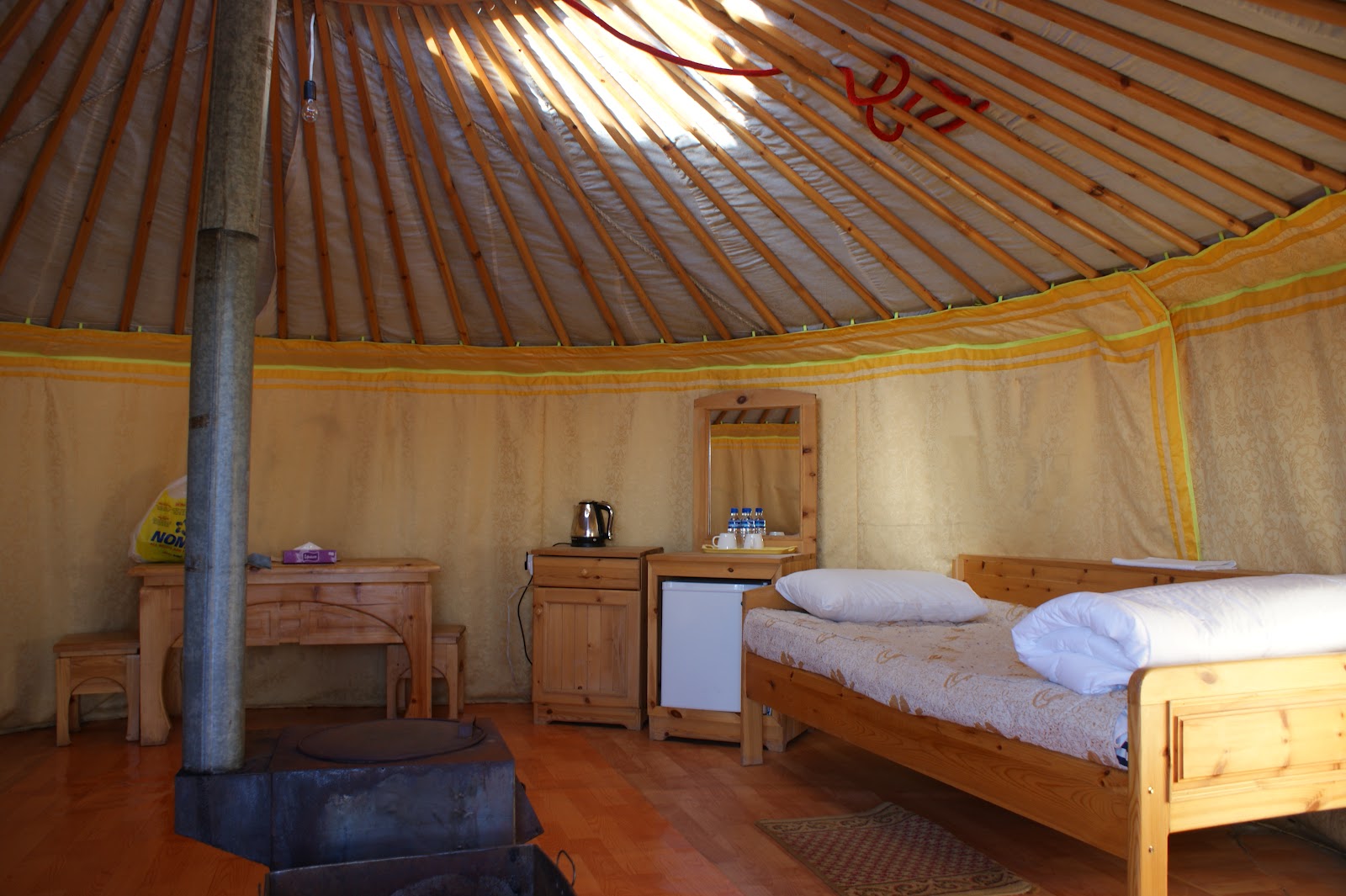
We stayed in a Ger camp last night.  These were my digs! (Night before last, we stayed in a privately-owned Ger.  That one gets its own special post because it was an exprerience unlike any other!)

 
Hatnaa and me at the Erdene Zuu Monastery - Mongolia's first Buddhist monastery founded in 1586.


Bactrian Camels (double-hump) on the steppe plains of Central Mongolia.


Thursday, September 20, 2012

Mr. Deputy Mayor

Just a short post this morning.  I received an invitation to meet with Deputy Mayor Purevdavaa, the newly elected mayor of the captial city of Ulaanbaatar at 11:00 a.m. today!  I'm very excited to meet with him.  I wonder if the issues and challenges he faces are similar to those of our mayors?  The mayoral candidates run on a slate of candidates from each political party so it is very partisan. 

 
Davaakhuu Purevdavaa, Vice-Mayor of Ulaanbaatar City in charge of Industry and Ecology


(Note:  In Ulaanbaatar, the mayor and deputy mayors are all referred to as mayor. Mayor Purevdavaa is deputy in charge of industrial and ecological sectors of the city's administration. We had a productive meeting. He asked to continue our discussion and asked if KLC would be interested  in a cooperative agreement so that we could exchange information about public participation and engagement in some of their thorny issues such as public concerns over environmental issues related to the booming industrial and mining sectors. He is a very intense gentleman with many responsibilities. We had a thirty minute discussion which is an eternity for any mayor!)

In the August 2012 elections, the Democratic Party, also known as the Reform Party, won the national races for the first time since 1996.  Every person I've met this week has expressed the uncertainty that looms over Mongolian politics and there seems to be an uneasiness in the capital city among the NGO's and technocrats which is understandable.  Really, not that much different from the US following an election in which party control changes hands.

Immediately following the meeting, Hatnaa and I will travel to Khar-knorum, the ancient capital city of Chenggis Khan and the Mongolian Empire for the weekend.  It's about a 7 hour drive.  We'll visit some of the villages and soums (small cities) along the way.  We're staying with some of Mongolia's nomads in a Ger camp which are essentially tent cities.  I'm not talking about camping tents either.  They are about as big as a small house back in Kentucky.  Can you believe some of them have wi-fi?  Even the nomads are "connected."

Here are a couple of photos of a Ger tent. One of the community development organizations that I met with yesterday has its office in a Ger.


I'm looking forward to this adventure, and I'll take plenty of pictures.  I'll be out of touch for a bit, and the blog will resume when I get back.  I hope everyone has a great weekend!  Talk with you soon.